
Haverhill OUI Lawyer
Strategic OUI defense for Haverhill residents and anyone arrested in Haverhill or on the I-495 corridor. Attorney Adela Aprodu represents clients in Haverhill District Court — first-offense 24D, breath test challenges, refusal suspensions, and RMV implied-consent hearings.
OUI Defense in Haverhill, MA
Haverhill OUI cases usually start with a stop on I-495, Route 110, Route 125, or Route 97 — the corridors Haverhill Police and the Massachusetts State Police watch most closely. From there the charge is arraigned at Haverhill District Court, 45 Ginty Boulevard, whether it is a misdemeanor first or second offense or a felony (a third or subsequent offense, or OUI causing serious bodily injury under M.G.L. c. 90 § 24L); the Commonwealth keeps the option of indicting the worst cases — OUI manslaughter under § 24G, for example — to Essex County Superior Court.
What the charge costs depends on where it sits on the statute's ladder — and every rung also carries Registry of Motor Vehicles consequences that run on their own schedule, independent of the courtroom. A refusal suspension starts immediately, and the RMV allows just 15 days to request a hearing; miss that deadline and the challenge is forfeited. Attorney Adela Aprodu manages the court case and the RMV side together from the first call. Here is the ladder, rung by rung:
- First Offense OUI — the bottom rung: a misdemeanor punishable by up to 2.5 years in the House of Correction, a $500–$5,000 fine, and a 1-year license loss. Resolving under 24D shrinks the suspension to 45–90 days
- Second Offense OUI — jail becomes mandatory: 60 days to 2.5 years HOC with 30 days that cannot be suspended, fines of $600–$10,000, and 2 years without a license. Cahill treatment-based relief exists when the offenses are 7+ years apart
- Third Offense OUI — the felony threshold: 180 days to 5 years in state prison, an 8-year license revocation, and indictment to Essex County Superior Court
- OUI with Serious Bodily Injury — a § 24L felony at any offense level, punishable by up to 10 years in state prison
- OUI Manslaughter — the top of the ladder: a § 24G felony carrying up to 15 years in state prison and no license for at least 15 years
- Breathalyzer Refusal — not a rung but a parallel penalty: suspensions of 180 days, 3 years, 5 years, then lifetime, contestable only through an RMV hearing requested within 15 days
About the Court — Where Haverhill OUI Cases Are Heard
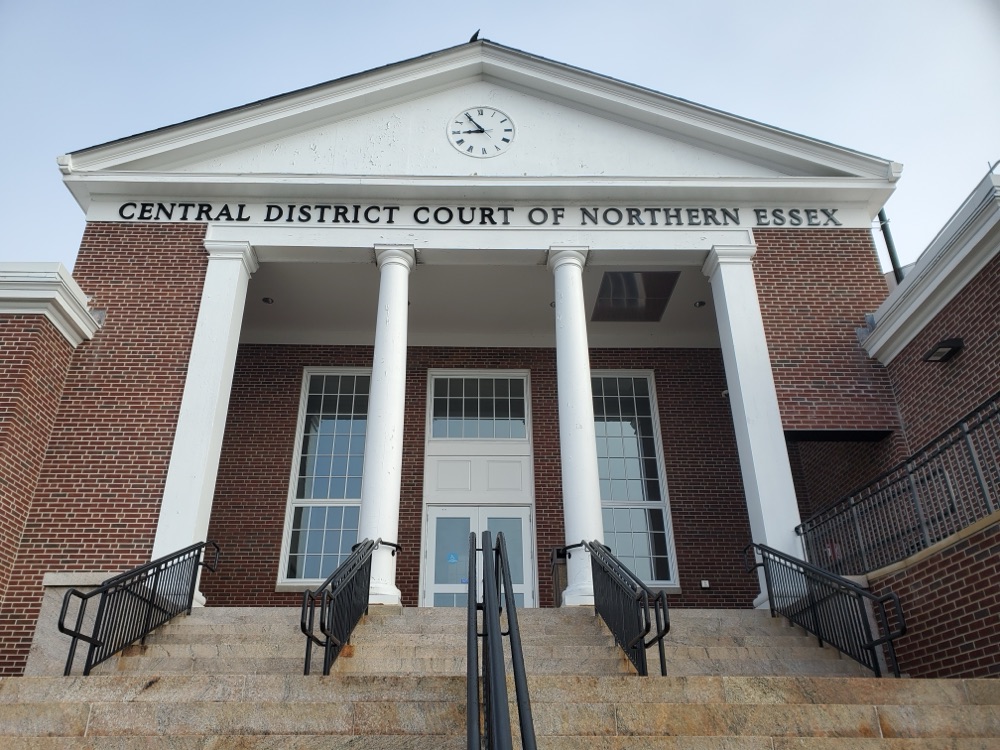
Haverhill OUI cases are heard at Haverhill District Court, at 45 Ginty Boulevard in Essex County. First and second-offense OUIs are handled here from arraignment through trial; the most serious felony cases can be indicted to Essex County Superior Court.
Attorney Adela Aprodu tries OUI cases statewide and works regularly in the Essex County courts. Familiarity with the building, the sessions, and the District Attorney's office shapes how a case is positioned at arraignment, argued at suppression, and presented at trial.
Haverhill OUI Stop Locations and Arresting Agencies
- I-495 and the highways — many Haverhill OUIs are Massachusetts State Police stops on I-495 and connecting routes. MSP report formats, instruments, and supervisory chains differ from local PD
- Main Street and River Street — Haverhill Police make stops along these commercial corridors; downtown and nightlife patrols intensify Thursday–Saturday nights
- Route 97 and the downtown district — secondary patrol corridors and common late-night routes through the city
- Sobriety checkpoints — MSP runs occasional checkpoints in Essex County. Under Commonwealth v. McGeoghegan, checkpoints must be announced in advance and follow a written protocol; deviations open suppression challenges
Haverhill OUI: Court, RMV & Enforcement Logistics
- District Court (misdemeanor OUI) — first and second offenses are arraigned and tried at Haverhill District Court, 45 Ginty Boulevard, Haverhill.
- Felony OUI — third or subsequent offenses, OUI causing serious bodily injury, and OUI manslaughter are indicted to Essex County Superior Court, Lawrence (43 Appleton Way) or Salem (56 Federal Street).
- License & the RMV — reinstatements and license business for Haverhill drivers run through the Lawrence RMV Service Center, 73 Winthrop Avenue, Lawrence; suspension and implied-consent appeals go to the Massachusetts Board of Appeal in Boston.
- Highway enforcement — Haverhill's surface roads (Routes 110, 125 and 97) fall under the State Police Newbury Barracks, while the I-495 corridor through Haverhill is patrolled by the State Police Andover Barracks (Troop A).
- Local enforcement — Northern Essex County sees recurring announced State Police sobriety checkpoints, and the Haverhill Police Department publishes weekly arrest logs that regularly include OUI arrests.
How Haverhill OUI Cases Are Defended
Every Haverhill OUI defense begins with the same audit: the stop, the roadside testing, and the machine. If the officer lacked a lawful reason to pull the car over, everything that followed falls with it. If the field sobriety tests strayed from the standardized protocol, their scoring loses its force. And the breath number itself — produced by the Draeger Alcotest 9510 — is only as good as the instrument's calibration and certification records and the 15-minute observation that must precede the test; Commonwealth v. Ananias turned those records into a statewide battleground, and results are routinely excluded. Drug-based OUI charges are even harder for the Commonwealth to prove: there is no per se threshold, no breath test, and under Commonwealth v. Gerhardt no roadside test may be offered as evidence of marijuana impairment.
Go deeper: OUI/DUI defense overview · breathalyzer challenges · field sobriety tests.
Your License After a Haverhill OUI
License consequences arrive before the criminal case is decided. A first breath-test refusal means a 180-day suspension all by itself; a driver with prior refusals faces 3 years, 5 years, or lifetime loss. Just 15 days are allowed to ask the RMV for a hearing on that suspension. Most first offenders can pursue a hardship (“Cinderella”) license, and under Melanie's Law an ignition interlock device is mandatory from the second offense on.
Related reading: refusing the breath test · hardship licenses · OUI penalties.
Key Takeaways
- Haverhill District Court keeps first and second-offense OUIs; third offenses and injury cases are felonies that Essex County Superior Court can take by indictment
- The penalty ladder climbs fast: 24D relief on a first offense, mandatory jail on a second, state prison exposure from the third onward
- A 24D disposition is not a clean slate — it functions as a prior for any OUI within the next 10 years
- The RMV suspension has its own 15-day hearing deadline and its own outcome, whatever happens in court
- I-495 arrests usually mean State Police paperwork and protocols, which differ from Haverhill PD's and open different cross-examination angles
Frequently Asked Questions
Haverhill District Court, 45 Ginty Boulevard, is where a first or second-offense OUI from Haverhill is arraigned and tried. A felony count — third or subsequent offense, or OUI with serious bodily injury — starts in that same courthouse, though an indictment can move the gravest cases, OUI manslaughter among them, up to Essex County Superior Court. Separately, the Registry runs the implied-consent suspension on its own administrative track; it neither waits for nor depends on the criminal outcome.
For a first offense, M.G.L. c. 90 § 24D lets the case resolve as a continuance without a finding (CWOF) — the 24D program. It requires one year of probation with fees and completion of the 16-week DAE alcohol-education course; in exchange the license suspension drops from the full year to 45–90 days, and completing the program ends in dismissal rather than conviction. It still operates as a prior offense, though, if a second OUI comes within 10 years.
Yes — and the consequence lands at the RMV, not in the courtroom. Under implied consent the suspension is automatic: 180 days the first time, 3 years the second, 5 years the third, lifetime the fourth. At trial the jury never hears about it, because § 24(1)(e) bars a refusal from being used as evidence of guilt — sometimes a real strategic benefit. You have 15 days to request the RMV hearing, so move quickly.
Yes. On I-495 the arresting agency is almost always the State Police, which brings its own report format, its own breath-test instrument (typically a Draeger Alcotest), and its own supervisory review. MSP's written OUI investigation manual sets the standard troopers must follow — any deviation becomes a cross-examination point — and early discovery of the cruiser video often reveals what the paperwork left out.
Sixty days to 2.5 years in the House of Correction with a 30-day mandatory minimum, plus fines between $600 and $10,000 and a 2-year license suspension — that is the exposure for a second OUI within 10 years. If more than 7 years separate the two offenses, a Cahill disposition under M.G.L. c. 90 § 24D may let alcohol treatment stand in for the jail sentence.
At offense number three, under M.G.L. c. 90 § 24(1)(a)(1): a mandatory minimum of 180 days, state prison exposure up to 5 years, and an 8-year license revocation. Prior record aside, OUI causing serious bodily injury (§ 24L) is always a felony, and OUI manslaughter (§ 24G) can bring up to 15 years in state prison.
Massachusetts OUI/DUI Defense Resources
OUI Defense in Other Massachusetts Cities
Arrested somewhere else in Massachusetts? Attorney Aprodu covers these courts as well:
Free Consultation — (978) 406-9090
One conversation can clarify your Haverhill case. Consultations with Attorney Aprodu are free, confidential, and handled personally.
Contact the Firm