
Boston OUI Lawyer
Strategic OUI defense for Boston residents and anyone arrested in Boston or on the I-93 corridor. Attorney Adela Aprodu represents clients in Boston Municipal Court — first-offense 24D, breath test challenges, refusal suspensions, and RMV implied-consent hearings.
OUI Defense in Boston, MA
No Massachusetts city is policed as densely as Boston. Boston Police cruisers work the neighborhoods block by block while Massachusetts State Police cover I-93, Storrow Drive, and the Mass Pike (I-90), so a driver can pass through two agencies' territory in a single mile. Wherever in the city the arrest happens, a misdemeanor first or second offense is prosecuted at Boston Municipal Court, 24 New Chardon Street. Felony-level charges — a third or subsequent offense, or OUI causing serious bodily injury under M.G.L. c. 90 § 24L — open in that same courthouse, and the Commonwealth can take the gravest cases, OUI manslaughter under § 24G among them, to Suffolk County Superior Court by indictment.
Understand from day one that you are fighting on two fronts. The criminal charge moves through the courtroom on its own calendar, while the Registry of Motor Vehicles imposes its administrative suspension without waiting for any judge — refuse the breath test and the license consequence takes hold immediately, whatever later becomes of the charge. Only 15 days exist to demand the RMV hearing, and that clock pauses for no one. Attorney Adela Aprodu takes on both fronts from the first phone call.
A first offense is a misdemeanor punishable by up to 2.5 years in the House of Correction, a fine of $500–$5,000, and a one-year loss of license. In practice, most Boston first offenders resolve the case through the 24D alternative: a year of probation and a 16-week driver alcohol education (DAE) program in exchange for a suspension shortened to 45–90 days. The trade-off is real — the CWOF that 24D produces counts as a prior if a second OUI arrives within 10 years.
A second offense escalates everything: 60 days to 2.5 years in the House of Correction with a 30-day mandatory minimum, fines of $600–$10,000, and a two-year license suspension. Where more than seven years separate the two incidents, the Cahill disposition can substitute supervised alcohol treatment for the mandatory jail term.
The third offense is where OUI becomes a felony — 180 days to 5 years in state prison and an 8-year license revocation. A crash that seriously injures someone triggers § 24L, carrying up to 10 years; a death can be indicted as OUI manslaughter under § 24G, with up to 15 years in state prison and a minimum 15-year license loss.
Declining the breath test carries its own price under implied consent: a 180-day suspension for a first refusal, then 3 years, 5 years, and lifetime for each refusal after that — and the same 15-day deadline applies to contesting it.
For Boston professionals, the collateral fallout often outweighs the statute book. Hospital credentialing, bar and securities licensure, security clearances, and immigration status can all be touched by an OUI disposition. Anyone who drives for a living faces sharper stakes still: a CDL holder risks disqualification rules far harsher than those governing an ordinary license, and rideshare drivers can be deactivated by their platform on the arrest alone, long before a courtroom ever sees the case.
About the Court — Where Boston OUI Cases Are Heard
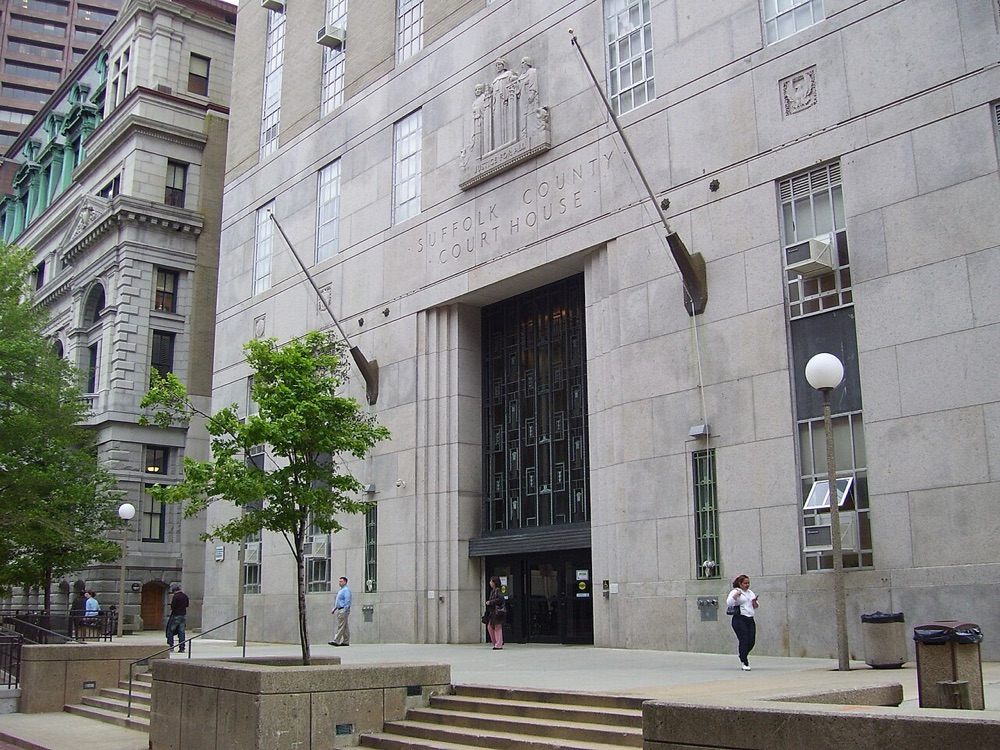
The Boston Municipal Court is its own department of the Trial Court, distinct from the District Court system that hears OUI everywhere else in the Commonwealth. For OUI purposes the address that matters is 24 New Chardon Street in Suffolk County, where first and second offenses proceed from arraignment through trial. When the Commonwealth pursues a felony OUI by indictment, the case moves up to Suffolk County Superior Court.
Courthouse familiarity is not a slogan — knowing how a particular session manages its list, which prosecutors staff the OUI call, and how motion dates actually get scheduled changes what a defense lawyer can realistically ask for at each stage. Attorney Adela Aprodu brings that working knowledge into the Suffolk County courts, from the first appearance through pretrial conferences, evidentiary hearings, and trial.
Boston OUI Stop Locations and Arresting Agencies
- I-93 and the highways — the interstate through Boston belongs largely to the Massachusetts State Police, and a trooper's arrest arrives with its own paperwork, its own breath-test instruments, and its own supervisory chain — each a distinct target for cross-examination compared with a local-department stop
- Boylston Street and the downtown district — these commercial corridors are Boston Police territory, and patrol density climbs noticeably from Thursday evening through the weekend
- the entertainment and nightlife districts — late-night routes out of the city's bar districts draw consistent attention from patrol units watching for the marked-lane and equipment violations that justify a stop
- Sobriety checkpoints — when the MSP operates a checkpoint in Suffolk County, Commonwealth v. McGeoghegan requires advance public announcement and adherence to a written operational plan; any departure from that plan is grounds for a suppression motion
Boston OUI: Court, RMV & Enforcement Logistics
- District Court (misdemeanor OUI) — arraignment and trial for first and second offenses take place at the Edward W. Brooke Courthouse, home of Boston Municipal Court, Central Division, 24 New Chardon Street, Boston.
- Felony OUI — when a third or subsequent offense, OUI with serious bodily injury, or OUI manslaughter is indicted, it is prosecuted at Suffolk County Superior Court, 3 Pemberton Square, Boston.
- License & the RMV — the Boston (Haymarket) RMV Service Center at 136 Blackstone Street handles reinstatements and license transactions for city drivers, and breath-test refusal hearings there are conducted in person; challenges to suspensions and implied-consent findings go before the Massachusetts Board of Appeal in Boston.
- Highway enforcement — Troop H of the State Police covers I-93 and the Southeast Expressway; Troop E covers the Mass Pike (I-90) and the harbor tunnels; Boston Police work the downtown and nightlife corridors.
- Local enforcement — the I-93 Southeast Expressway sees more OUI patrol activity than any other corridor in the city, and MSP checkpoint operations in Suffolk County are announced in advance.
How Boston OUI Cases Are Defended
Every OUI prosecution in the city has to survive three separate examinations. First, the stop: in dense Boston traffic, officers often cite driving patterns — a lane drift, a slow rolling stop — that have entirely innocent explanations, and a stop that fails constitutional scrutiny takes the whole case down with it. Second, the roadside exercises: uneven pavement, oncoming headlights, cold, and crowds make Boston street-side testing conditions a rich vein for cross-examination. Third, the machine: the Draeger Alcotest 9510 produces the Commonwealth's number, and the statewide litigation in Commonwealth v. Ananias showed how often calibration, certification, and 15-minute-observation failures make that number excludable. Where the allegation is drugged driving, the Commonwealth's hand is weaker again — no instrument, no per se threshold, and Commonwealth v. Gerhardt bars offering roadside tests as proof of marijuana impairment.
Go deeper: OUI/DUI defense overview · breathalyzer challenges · field sobriety tests.
Your License After a Boston OUI
The Registry's suspension machinery runs on its own schedule, and for many Boston clients it is the more urgent problem — the T covers a lot of ground, but plenty of jobs, school runs, and family obligations still depend on a car. Refuse the breath test and the RMV suspends your license for 180 days on a first offense, with repeat refusals escalating as far as lifetime loss, and just 15 days exist in which to request the hearing that contests it. A hardship “Cinderella” license restores limited driving privileges for most qualifying first offenders, and Melanie's Law makes an ignition interlock device mandatory for anyone with a second or subsequent offense.
More on license issues: refusing the breath test · hardship licenses · OUI penalties.
Key Takeaways
- Boston Municipal Court at 24 New Chardon Street handles misdemeanor OUI; felony indictments go to Suffolk County Superior Court
- Two agencies police the city's roads — Boston PD in the neighborhoods, MSP on I-93, the Pike, and the tunnels — and the arresting agency shapes the evidence
- Professional licenses, security clearances, CDLs, and rideshare eligibility can all take a hit before the criminal case even resolves
- The RMV hearing must be requested within 15 days — the administrative suspension does not wait for the court case
- The 24D disposition shortens the suspension but leaves a CWOF that counts as a prior for the next 10 years
Frequently Asked Questions
First- and second-offense OUI charges from anywhere in the city are prosecuted at Boston Municipal Court, 24 New Chardon Street. A felony OUI — a third or subsequent offense, or one causing serious bodily injury — starts in the same courthouse, but the Commonwealth can indict the most serious cases, including OUI manslaughter, to Suffolk County Superior Court. Keep in mind that the Registry of Motor Vehicles suspends your license on its own administrative track, and nothing the criminal court decides automatically undoes an RMV suspension.
The 24D disposition is the standard first-offense resolution in Massachusetts: the court continues the case without a finding (a CWOF) under M.G.L. c. 90 § 24D while you complete a year of probation and the 16-week driver alcohol education (DAE) course. Your license suspension drops from the full year to 45–90 days, and the charge is dismissed once probation ends — no conviction enters. The catch is durable, though: for the next 10 years that CWOF is treated as a first offense, so any new OUI within the window is charged as a second.
Refusal is legal, but it costs your license: the implied-consent statute imposes 180 days of suspension for a first refusal, 3 years for a second, 5 years for a third, and lifetime for a fourth. What you gain is evidentiary — under § 24(1)(e) the jury never hears that you refused, leaving the Commonwealth without a number at trial. Whether that trade favors you depends on your record and the rest of the evidence, and you have just 15 days to request the RMV hearing.
It matters a great deal. An I-93 arrest almost always means the Massachusetts State Police, whose reports, breath-test devices (typically a Draeger Alcotest), and supervisory review all differ from Boston PD's. Troopers are trained to a written OUI investigation manual, and every point where the arrest deviated from that manual is material for cross-examination. Cruiser and booking video should be requested in discovery right away — footage regularly contradicts the narrative in the written report.
Sixty days to 2.5 years in the House of Correction, of which 30 days must actually be served, plus a fine between $600 and $10,000 and a 2-year license suspension. If your first OUI was more than 7 years ago, ask about the Cahill alternative under M.G.L. c. 90 § 24D, which lets qualifying second offenders complete an alcohol treatment program instead of serving the mandatory jail portion.
The third offense is the felony line under M.G.L. c. 90 § 24(1)(a)(1): a mandatory minimum of 180 days, a maximum of 5 years in state prison, and an 8-year license revocation. Two paths reach felony status sooner — OUI causing serious bodily injury under § 24L is a felony even on a first arrest and carries up to 10 years, and OUI manslaughter under § 24G exposes a driver to as much as 15 years.
Massachusetts OUI/DUI Defense Resources
OUI Defense in Other Massachusetts Cities
OUI defense is a statewide practice for Attorney Aprodu. These pages cover the local court and enforcement details for other Massachusetts communities:
Free Consultation — (978) 406-9090
Call to discuss your Boston OUI with Attorney Adela Aprodu directly — no intake screeners. The consultation costs nothing and stays confidential.
Contact the Firm